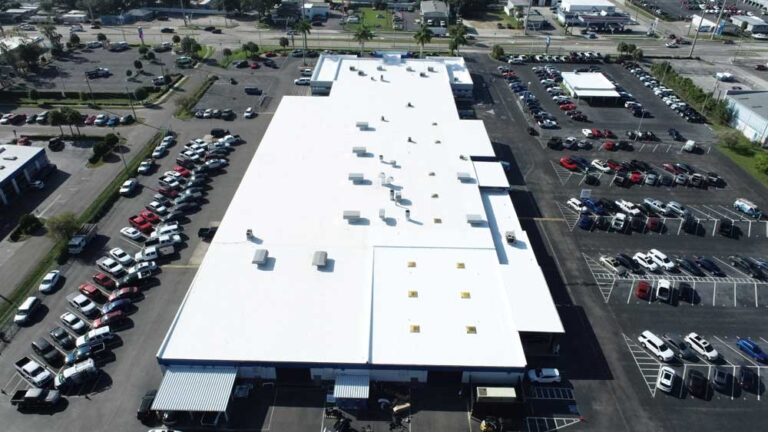
What to Expect: Commercial Flat Roof Replacement
Commercial flat roof replacement is a significant undertaking, with many diverse elements that can impact the cost, timeline, and complexity of the overall project. Contractors will take into account the height of the building, ease of access, the scope of the replacement and the type of roofing system to be installed. Other factors that will influence the project include weather conditions and climate at the time of replacement.

Every roofing situation – and its solution – is unique, and there is no universal approach to commercial flat roof replacements. An experienced professional commercial roofing contractor will conduct a comprehensive in-person evaluation of the existing roof to assess its current condition and make recommendations as to potential solutions for repair.
There are many variables to consider when identifying the scope of any commercial flat roof replacement, such as if the existing roof needs a complete replacement, or if industrial equipment needs to be removed before any work is done. The contractor will also factor in the number and types of layers on the existing roof and the overall depth of the removal/replacement; as well as the new commercial roofing system being installed.
There are several aspects of the plan that must be outlined, such as:
Safety: Describes protection in place to prevent falls, personal protection for contractors, protection and safety for building occupants, and public protection (such as people in the parking lot or on the street.)
Staging: Identifies employee access to the roof, the location of roofing equipment, and recommended staging areas for toilets, dumpsters, cranes, or other large on-site equipment.
Phasing: Outlines the expected daily work area for coordination with property management and building occupants. This will also document the days and times that will have the greatest impact on building users, such as when the roof is being removed, or when drilling will take place.
The details of the commercial roof replacement are influenced by the type of building involved. For instance, a warehouse will have different parameters than a medical office based upon the comfort and safety of the people within the building.
Inevitably, there is likely to be a disruptive level of noise. The project managers may need to limit work to specific times when actual overhead work is being done. They can also take measures to reduce noise disruption, including performing those noisier tasks earlier in the morning, later in the evening, on the weekends, or whenever there can be flexibility with the customer.
Total Roof Replacement May Not Be Necessary
Experts have indicated that many total roof replacements are not necessary at. Let’s rewind to the assessment stage of this project. If the majority of the structure is serviceable, it may be easier to repair the roof than to commit to a full replacement.
Roof coatings have evolved into one of the most effective and efficient ways to repair a commercial flat roof. Roof coatings can restore performance, prevent leaks, protect the building and extend the life of the roof. Roof coatings create a durable, seamless membrane that is breathable, waterproof, and permanently flexible, offering an extra layer of protection against extreme climates and hazard. (Read more about the benefits of roof coatings.)
While a roof repair can be expensive, time consuming and disruptive, roof coatings are cost effective, non-invasive and can be completed rapidly.
The best way to determine whether or not roof coatings are an appropriate solution for your commercial flat roof is to ask a roofing professional. Unicoat Industrial Roofing has applied over 4 million gallons of roof coatings and is known as an industry leader. Before you commit to a new roof, call today for an evaluation.