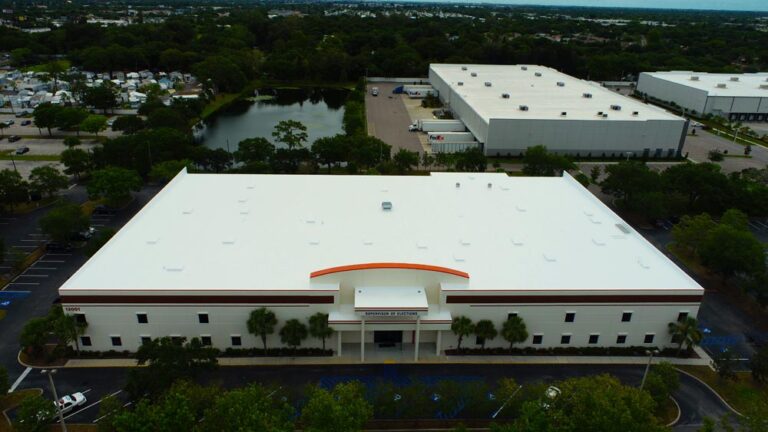
Adding Roof Penetrations to a Commercial Building
There are many reasons why you may need to modify your commercial roof—from adding new pipes or coax cables to installing a new HVAC unit or ventilation system. Ensuring that these new penetrations are sealed properly can mean the difference between never-ending maintenance issues and a completely watertight roof. Hiring a roofing contractor to guarantee that the penetrations are flashed and sealed properly is imperative.

There are three different methods for flashing new penetrations:
- Premanufactured Flashing: Also known as a “boot”, this type of premade flashing is conical in shape, and typically seamless in order to guarantee a watertight seal. The boot is designed to slide
over a pipe before it is heat-welded or sealed to the surface of the roof field. The sealing process is much more efficient when the flashing does not need to be fabricated, resulting in a more affordable solution that requires less labor. - Field Wrap Flashing: When premanufactured flashing is not appropriate for the task, a boot can be fabricated from a non-reinforced membrane. Scenarios making this necessary may include continuous piping or oversized, tall, or oddly shaped penetrations. The roofing contractor will weld detail membrane to the roof around the base of the penetration and caulk the field wrap flashing with sealant around the top of the penetration. The field fabrication is then clamped to ensure it is appropriately sealed. Although this method requires more labor, it is the best alternative when a penetration is otherwise tricky to flash.
- Pitch Pans: Also referred to as pitch pockets, pitch pans used to be a standard solution – but are now considered a last resort alternative. The process involves welding pre-made pitch pans directly to the roof membrane. Pourable bituminous or polymeric sealant is applied on top and built into a slope to ensure that water runs down and away from the penetration. Pitch pans require much more maintenance than the other methods, which is why they have fallen out of favor. The sealant shrinks and dries out over time, causing it to shrivel and pull away from the sides. Once this happens, the concave sealant may trap water, resulting in leaks and water intrusion.
Steps Involved in Installing Penetrations
You should always hire a professional roofing contractor to properly flash/seal any existing or new roof penetrations on a commercial roof. A reputable roofing company will have the experience to work safely on the roof and will properly complete the flashing detail according to manufacturer and industry specifications.
Here is what you need to know about the process:
- If any new roof penetrations are necessary—such as the required installation of a vent or pipe—the manufacturer of your current roof system should be notified to ensure any work will not void the warranty. The manufacturer may request an inspection to confirm that any new penetrations were correctly installed. Check to make sure that your roofing contractor is licensed and approved by the roof system manufacturer.
- Connect your roofing contractor with the entity that is installing the new penetration, such as the cable company or HVAC installer. This will allow them to agree on the best location of the penetration and settle any decisions that must be made about appropriate flashing.
- Plan to complete the work when both contractors are available to avoid a delay in sealing the new penetration. Task the roofing contractor with any roofing work—a technician not familiar with roofing systems can easily damage the roof membrane and complicate the project.
Roof Coatings by Unicoat Industrial Roofing
If you need to seal your roof or have flashings that need repair, call Unicoat Industrial Roofing. Our team of professionals brings seven decades of experience to your project, whether repair or replacement is required.